Cascading reels replace eligible symbols after a winning evaluation and check the resulting grid again under the game’s rules. A sequence can therefore contain several evaluations after one starting action, with some feature state carried forward. The name does not tell you every removal condition, charging rule or stopping rule; those belong to the identified product’s official documentation.
Sources: GAME COVER
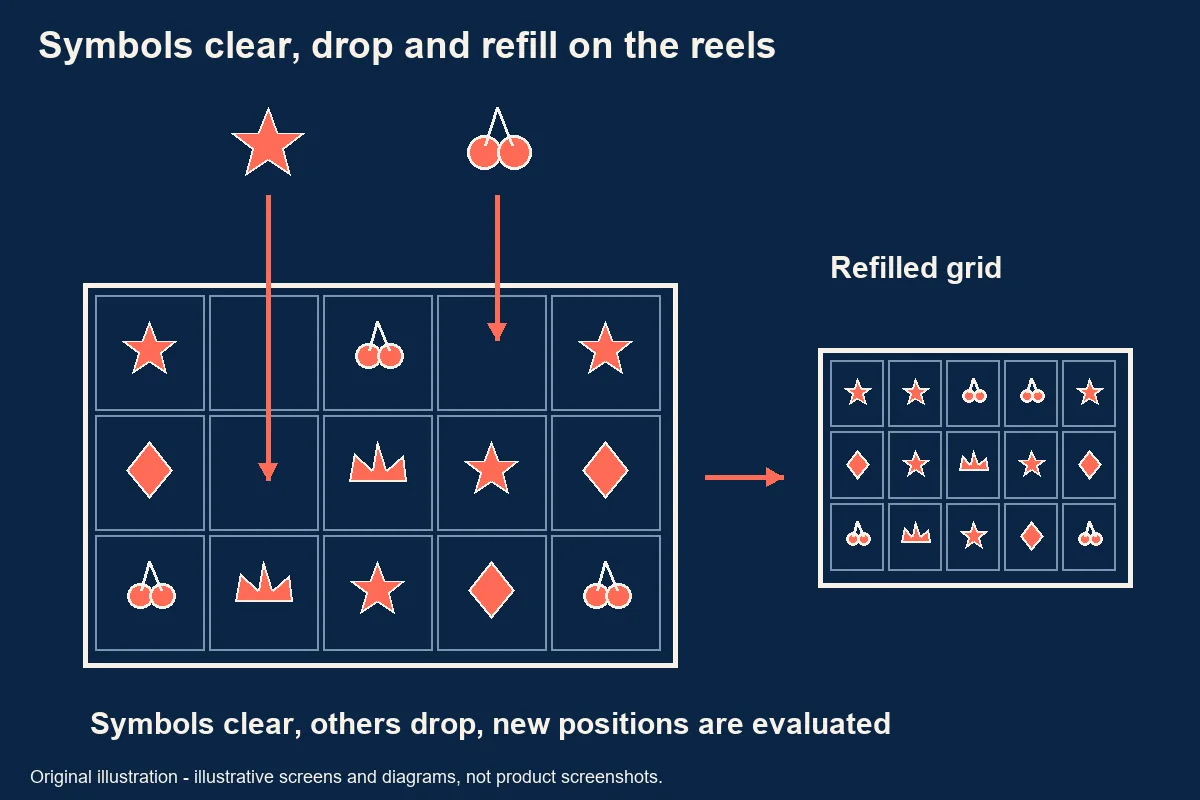
What a cascade is
A cascade is a clear-and-refill process within a defined game sequence. Read it as a change to positions on the grid rather than as a new promise of a win. The basic questions are which positions change, how the replacement happens and whether the revised layout is evaluated again. Those questions describe the mechanism without requiring a product review or a numerical return claim.
The PG SOFT information document checked here describes symbols cascading down and explains associated transformations and round-dependent feature behaviour. We use that document to show why the full sequence matters. A brief animation or the single word “tumble” would not, on its own, explain all the state that the written rules can preserve.
Our diagrams use abstract blocks rather than genuine game symbols. A highlighted block represents a position selected for explanation; it is not an official winning combination. The pictures teach the order of operations. They do not supply a paytable, depict an observed session or imply that every cascade product uses the same grid.
Evidence: GAME COVER · Retrieved 2026-10-31.
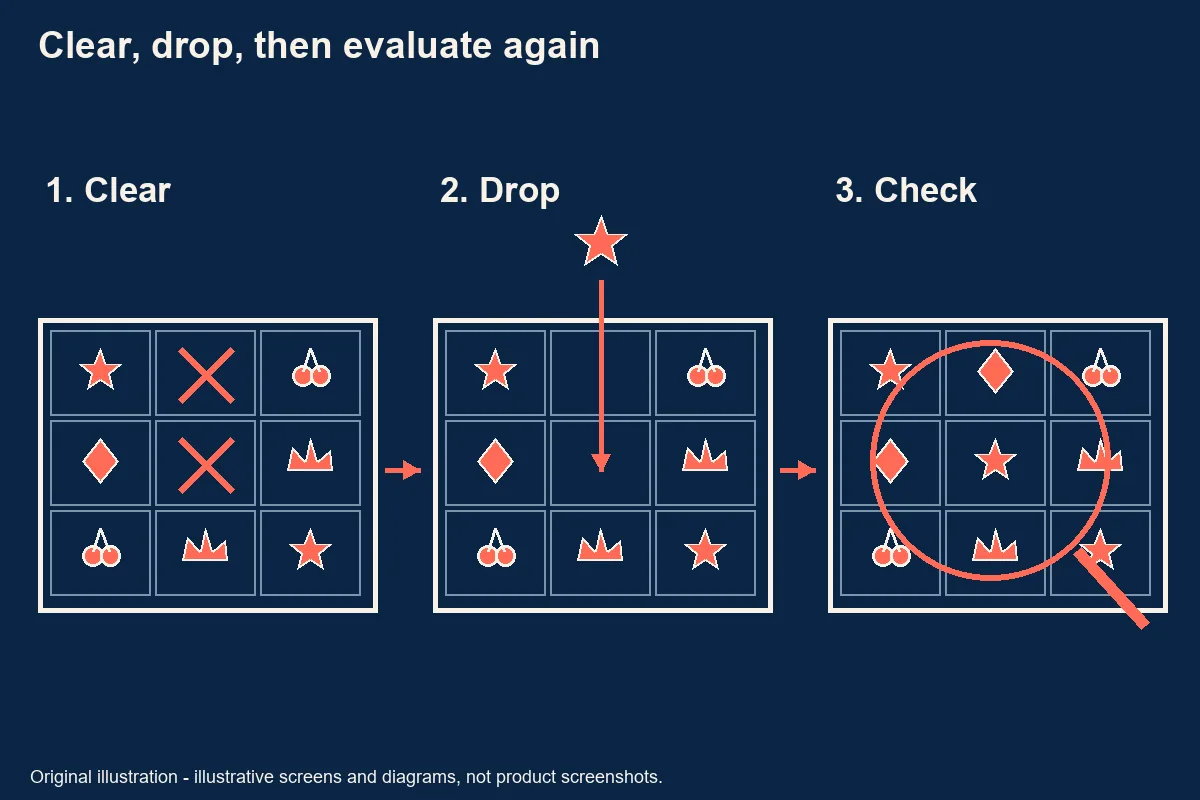
Step by step: clear, drop, re-evaluate
Read each stage separately, because removal, replacement and evaluation are different actions. A rule can add exceptions at any stage. The checked PDF, for example, discusses special-symbol transformation in relation to a previous win and newly cascaded symbols. That kind of wording makes a sequence more specific than “everything disappears and starts over”.
Which symbols are removed
Start by identifying the positions to which the rule applies. A winning evaluation does not automatically mean that every visible symbol is cleared. Special symbols may have different treatment, and a participating symbol may transform rather than simply vanish. The exact removal set for a product must come from its own rules; a generic illustration cannot settle that detail.
For a hypothetical reading exercise, mark a few eligible positions on a blank grid and leave the rest unmarked. The exercise asks what changes and what stays. It does not assign a winning value to those positions or suggest that the pictured arrangement would actually win. Keeping the diagram abstract prevents a made-up paytable from slipping into an explanation.
How empty positions are filled
Next, determine how the game describes replacement. The term “cascaded down” in the checked source identifies a downward movement within that product’s feature explanation. It should not be used to claim that every supplier animates replacement identically. Another product’s rules may describe its own refill process and exceptions differently.
Separate appearance from rule effect. A falling animation explains how a transition is shown; the rules determine how the resulting state is evaluated. Watching blocks move cannot reveal a random-number method or prove that a particular replacement was more likely. This article did not inspect an implementation or perform a statistical test.
When the sequence stops
The stopping condition belongs to the documented feature, not to a reader’s expectation that a chain should continue. In a simple teaching model, the revised grid is checked and the sequence stops when no further qualifying event remains. That is an explanatory model, not a substitute for a product’s exceptions, caps or separately triggered features.
Look for any additional end conditions in the actual rules. A document may distinguish a base sequence from a bonus stage or describe how accumulated state resets. If those conditions are not available, mark them unverified [待核實]. Do not infer an unlimited continuation from a short promotional clip that happens to show several replacements.
Evidence: GAME COVER · Retrieved 2026-10-31.
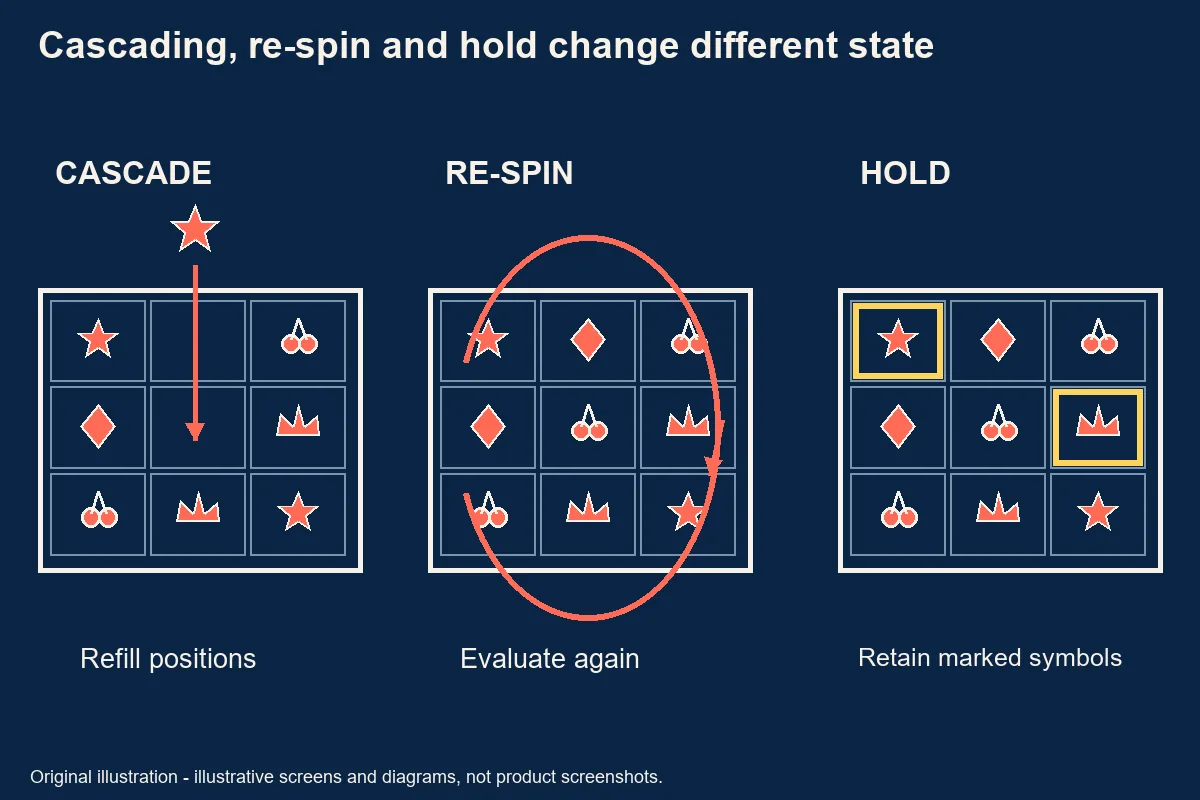
Cascades versus re-spins and hold features
These names describe different rule ideas, so the trigger and retained state matter more than the label alone. A cascade concerns clearing and refilling positions. A re-spin describes another spin or evaluation within the stated feature. A hold mechanism concerns retaining specified positions or symbols while other parts of a feature continue. These are conceptual distinctions, not a claim that products cannot combine them.
A useful comparison asks four questions: what starts the feature, what changes, what is retained and what ends it. The answers must be filled from each product’s rules. Writing “cascade” in one column and “re-spin” in another is insufficient if both columns omit those conditions. Similar animations can conceal different evaluation sequences.
The checked PG document illustrates why carried state needs attention: its transformation and multiplier explanations refer to stages within a sequence. We do not transfer those particular conditions to every game with moving symbols. The example establishes a reading method, not a universal feature specification.
Evidence: GAME COVER · Retrieved 2026-10-31.
Why a cascade chain is not a streak
A chain is a sequence defined by rules and does not establish that an unrelated future game is due to continue it. Describing several linked evaluations as a “hot streak” adds a prediction that the evidence does not support. At the same time, it would be inaccurate to declare every stage inside a feature identical and independent when its rules explicitly carry state forward.
Independent outcomes per RTS 7 wording
The UK Gambling Commission’s RTS 7 requires acceptably random results, prohibits compensated adaptive behaviour and discusses implementation according to stated rules. Its guidance also distinguishes permitted bonus or special features with different rules from prohibited probability-changing interventions. The wording should be read in that scope; it is not a blanket statement that a feature cannot remember its own multiplier or transformed symbols.
This UK technical standard is a comparative reference, not Philippine law or a certification of the product discussed here. PAGCOR’s licensing page provides a separate Philippine regulatory context. Neither link proves that this article has audited a random-number generator or verified a particular operator’s current deployment.
Evidence: GAME COVER · Retrieved 2026-10-31. Remote gambling and software technical standards (RTS) - RTS 7 – Generation of random outcomes · Retrieved 2026-10-31. PAGCOR Regulatory site · Retrieved 2026-10-31.
Where to find the cascade rule inside a game
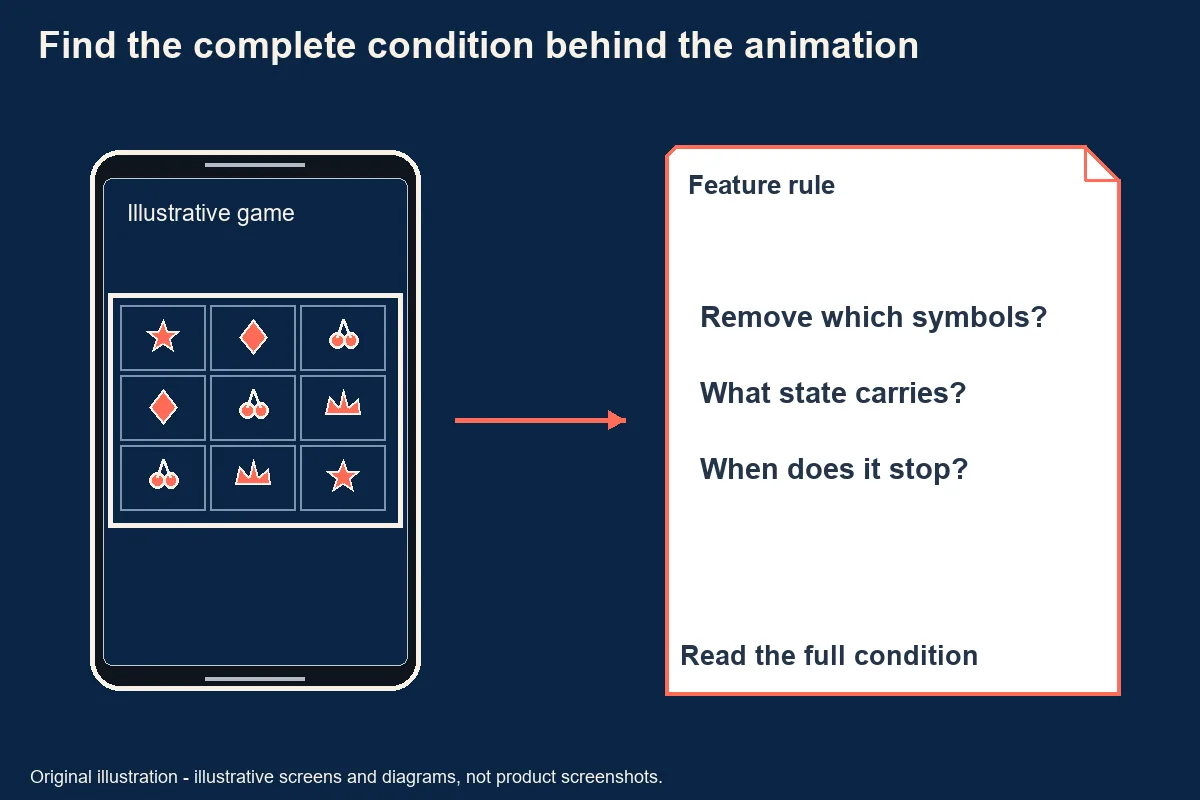
Find the written feature explanation rather than relying on an animation or a short product badge. In the checked PDF, the feature sections explain transformations and sequence-dependent behaviour, while the paytable is a separate section. Reading both kinds of material helps distinguish an event’s value from the process that leads to another evaluation.
Paytable / Rules screen labels
Labels such as Rules, Help, Features or Paytable can guide a search, but their exact location is not universal. Save the product title, version and relevant section when taking an editorial note. If a phone view hides part of the explanation, an incomplete capture should not be treated as a complete rule.
Evidence: GAME COVER · Retrieved 2026-10-31.
What this guide does not claim
This guide explains a mechanism and makes no product RTP, maximum-win or personal-return claim. It gives no timing method for starting a chain, no strategy for extending one and no statement that a displayed pattern changes the next independent outcome. Costs, caps and other unresolved product-specific conditions stay unverified until the exact official rules establish them.
Documents and evidence boundaries
- GAME COVER
URL subject and content checked; not operator endorsement · Retrieved 2026-10-31
- Remote gambling and software technical standards (RTS) - RTS 7 – Generation of random outcomes
URL subject and content checked; not operator endorsement · Retrieved 2026-10-31
- PAGCOR Regulatory site
URL subject and content checked; not operator endorsement · Retrieved 2026-10-31
Unverified details / 待核實
- If those conditions are not available, mark them unverified [待核實].
Questions and answers
Does a cascade cost an extra bet?
Read the exact rules and cost wording for the product. Several evaluations may belong to one initiated sequence, but the word cascade alone does not establish every product’s charging conditions.
GAME COVER Remote gambling and software technical standards (RTS) - RTS 7 – Generation of random outcomes PAGCOR Regulatory site
Is a longer cascade chain more likely after a big win?
No such forecast is supported here. Within a feature, stated rules may carry forward a multiplier or symbol state; that does not establish that a later independent game owes a longer chain.
GAME COVER Remote gambling and software technical standards (RTS) - RTS 7 – Generation of random outcomes PAGCOR Regulatory site
Are cascading reels the same as Megaways?
No. Cascading describes a clear-and-refill process, while a ways label concerns how combinations are evaluated. The presence of one does not establish a particular branded system or the other mechanic.
GAME COVER Remote gambling and software technical standards (RTS) - RTS 7 – Generation of random outcomes PAGCOR Regulatory site
Where is the cascade rule written in a game?
Look in the official Rules, Help or Paytable material for removal, refill, transformation and stopping conditions. Section names vary, so use the actual document rather than assuming a universal menu location.
GAME COVER Remote gambling and software technical standards (RTS) - RTS 7 – Generation of random outcomes PAGCOR Regulatory site